
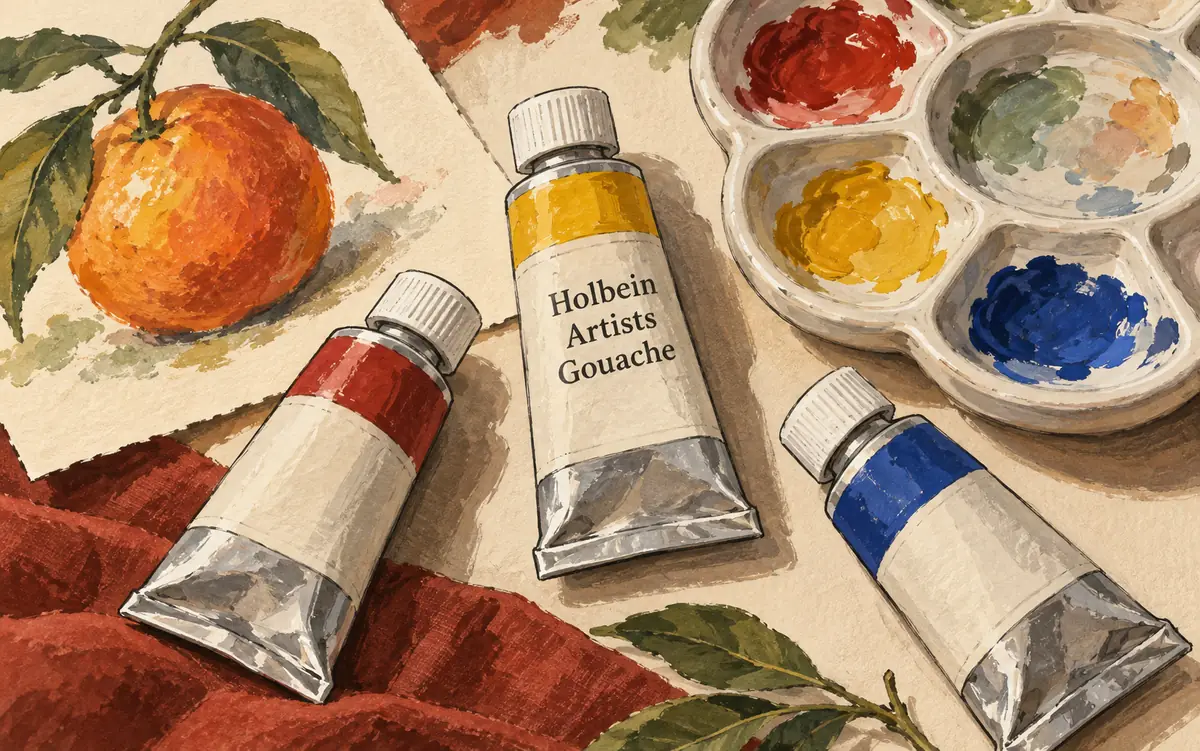
Gouache paint can turn a few simple shapes into a rich, flat picture. It can also turn muddy when a wet brush lifts the layer below. The paint you choose should fit the way you want to work.
I would start with a small set of Holbein Artists' Gouache for paper art and color mixing. Winsor & Newton is a strong choice if you want clear color data. Daniel Smith and Schmincke offer other artist-grade routes. Liquitex Acrylic Gouache suits a different need: dry layers that stay put.
That last choice matters more than the name on the tube. Regular gouache can soften again with water. Acrylic gouache dries into a film that water will not turn back into wet paint. Choose that behavior first.
Five gouache paints, five reasons to choose
| Paint | Why I would choose it |
|---|---|
| Holbein Artists' Gouache | A small, rewettable palette for drawing and mixing |
| Winsor & Newton Designers Gouache | Clear pigment, opacity, and fade-resistance data |
| Daniel Smith Extra Fine Gouache | Rich color without added white or fillers |
| Schmincke Horadam Gouache | A focused artist range with natural pigment opacity |
| Liquitex Acrylic Gouache | Flat color in layers that dry water-resistant |
The first four are traditional gouache paints. The fifth is acrylic. I would not mix those two types by accident or expect them to behave the same way on a dry palette.
1. Holbein Artists' Gouache: my first pick for paper art
Holbein Artists' Gouache is the range I would start with for small paintings, card art, and color studies. The maker lists 89 colors in 15 ml tubes and says it adds no whitening agents to raise the opacity.
My advice is to buy a few useful colors first. A red or magenta, a yellow, a blue or cyan, and white give you room to learn. Add a dark earth or black if it suits your work. A short palette makes it easier to see what each mix does.
The key trade-off is the same one that comes with traditional gouache: a damp brush can lift a dry layer. That can help you soften an edge. It can also spoil a clean second coat if you scrub it.
Read the range name on the tube. Holbein sells both traditional and acrylic gouache. For this pick, look for Artists' Gouache. The extra word on an acrylic label changes how you can reuse dry paint.
2. Winsor & Newton Designers Gouache: for careful color choices
Winsor & Newton Designers Gouache earns a place here because its color chart makes the trade-offs clear. You can check the pigment, opacity, and permanence of each shade.
That helps when a painting will hang on a wall. The chart does not give every color the same rating. Some bright pinks are listed as fugitive, which means they can fade. A color that suits a short-lived design may be a poor choice for a keepsake.
I would choose the actual colors before buying a large set. Check both the name and the pigment code. Two reds may look close in a shop photo but behave differently in a mix or over time.
This is also a reminder to look past a familiar logo. Student paint and Designers Gouache are separate ranges. Check the full name on the box, the tube size, and the colors inside.
3. Daniel Smith Extra Fine Gouache: for rich pigment mixes
Daniel Smith Extra Fine Gouache uses gum arabic and a high pigment load. The maker says it gets its covering power without adding white or other fillers.
I would consider it if you enjoy mixing and want the pigment itself to do much of the work. You can add white when you want a pale tint. You can keep it out when you want a deeper color.
No added white does not mean every color covers in the same way. Pigments vary. Test a stroke across a dark line and let it dry. That gives you a better sense of coverage than a thick blob straight from the tube.
I would begin with a small mixing group. Paint a page of greens from one blue and one yellow. Then change just the blue. That kind of study can teach more than adding ten new tubes at once.
4. Schmincke Horadam Gouache: for a focused studio palette
Schmincke Horadam Gouache is another artist range built around the natural opacity of its pigments. Schmincke lists 48 colors and says it does not add extra white to make them cover.
I would put it on the list for someone who paints often and already knows the colors they need. A small set of well-chosen tubes can serve a clear plan: muted plant studies, bold poster shapes, or a narrow range of earth tones.
Compare single-tube prices and local stock before you commit. A paint that is hard to replace can be a poor fit for daily work, even if the range sounds ideal. Keep the exact color name and code with your swatches.
I would still use a test card for each new color. The word “gouache” tells you the broad kind of paint. It does not tell you how one green will look next to your favorite red.
5. Liquitex Acrylic Gouache: for layers that stay put
Liquitex Acrylic Gouache is my pick when the goal is a flat finish with dry layers that resist water. The six-color Primaries set has six 22 ml bottles, including white and black.
This is acrylic paint with a gouache-like matte look. It suits crisp shapes, painted collage pieces, and work you want to scan. Let one layer dry, then add another without trying to wake the first one up with water.
The trade-off is waste and cleanup. Once a puddle dries on the palette, it will not turn back into usable paint. Put out small amounts and clean brushes before the paint dries in them.
I would choose this for a planned final piece. I would choose traditional gouache for a palette I want to return to and rewet. Neither habit is better for everyone.
Traditional or acrylic gouache?
| Your goal | My choice |
|---|---|
| Reuse paint that dries on the palette | Traditional gouache |
| Soften an old edge with a damp brush | Traditional gouache |
| Keep dry layers from lifting with water | Acrylic gouache |
| Make flat, matte color | Either type, with the right paint thickness |
| Mix on the page for a long time | Traditional gouache, used with care |
The difference comes up often among painters. In this discussion about a first gouache set, the buyer wanted paint they could rewet. A reply pointed them toward Holbein's traditional range. That is the first question I would settle too.
A water-resistant acrylic film is not the same as a promise that an object can go outdoors or through a dishwasher. The surface, paint layer, and finish still matter.
How much should gouache cover?
Gouache is often called opaque watercolor. Opaque means that it hides what is below. But a thin wash and a thick stroke of the same paint can look quite different.
Start with a small amount of paint and add water a drop at a time. For a flat shape, aim for paint that moves from the brush without running like colored water. For a light wash, add more water on purpose.
Try three swatches: one straight from the tube, one with a little water, and one thin wash. Let all three dry. Look for streaks, shine, and show-through. Keep the card beside your palette.
White can make a mix cover more, but it also changes the color. If every mix looks pale, try using less white. If a dark layer shows through, let it dry before adding a careful second coat.
Paper and brushes can change the result
I would spend part of a first-paint budget on sturdy paper. Watercolor paper is a useful place to start. Smooth paper suits fine lines, while more texture can show through a dry brush stroke.
A soft brush helps you lay down a layer without scrubbing the one below. Use a larger brush for a large shape. Trying to fill a whole background with a tiny point can leave rows of strokes.
For spare swatch cards, cut down a few sheets with a paper cutter that suits the paper. Keep the same paper for tests and finished work when you can. A new surface can change both the color and the way the brush moves.
Check fade resistance before making a keepsake
Lightfastness means how well a color resists fading in light. Check it by shade, not just by brand. A bright paint is not always a lasting paint.
The Holbein gouache color chart gives pigment and rating details. Use that kind of chart when you choose colors for a gift or a painting to display. Keep finished work out of direct sun.
I would be less concerned about a quick sketch that stays in a closed book. Even then, it helps to know what you bought. Good notes make the next purchase easier.
A smaller set can be the better buy
Compare the amount of paint, not only the number of colors. A box of tiny tubes may cost more per ml than a few larger ones. Also check how easy it is to replace the white, which can run out first if you mix many pale colors.
Start with colors you can name a use for. Make a few pages before adding more. The missing shade may be one you can already mix.
If you mostly want a neat line of opaque color, a brush and palette may be more setup than you need. Our POSCA markers review covers a pen-shaped way to make bold painted marks.
Gouache, watercolor, and the binder in the tube
A binder holds the pigment in a paint film. Gum arabic is a common water-soluble binder in both gouache and watercolor paint. The pigment gives color; the binder helps that color stay on the paper. An acrylic binder behaves differently once dry.
Think of watercolor as a way to let light through a wash. Gouache gives you a more opaque mark and a matte finish. You can dilute gouache paint for a transparent wash, but that does not make every pigment act like a clear watercolor.
Winsor & Newton's guide to gouache and watercolor techniques explains that its Designers Gouache can be mixed with watercolor paint. I would try that on a spare card first. A tiny bit of opaque gouache can change the clear look you liked in a watercolor mix.
What makes a matte finish useful?
A matte finish has little shine. That suits flat illustrations, small posters, and bold gouache colors you want to scan. You can create fine details over a dry shape with a light hand. A pale mark can cover a dark one when the paint is opaque enough.
For beginners, I would practice three techniques on one sheet: a thin watercolor-like wash, a flat opaque square, and a dry stroke with texture. Keep the same gouache color for all three. Changing the water lets you see which qualities come from the paint and which come from the way you use it.
Do not solve every streak with thicker paint
Too much water can weaken coverage. Too little can make the paint drag. Aim for a smooth consistency that leaves an even coat. Thick piles of regular gouache can crack, so add a thin second coat after the first dries instead of building a ridge.
A high pigment load can give vibrant color without a large amount of paint. Some formulas use chalk or other additives to change body and coverage. Added chalk is not the same as extra pigment, and a low price alone does not tell you the formula. Read the maker's details before judging cheaper brands.
Keep gouache ready for the next session
Wipe the tube thread and close the cap. Store art supplies away from heat and direct sun. An airtight palette lid can slow water loss, though no lid will make acrylic paint rewettable after it dries.
For traditional gouache, add a little clean water to a dry puddle and give it time to soften. Do not pour water into an entire tube. Keep the binder and pigment together in a small working mix. If a color stays gritty, fresh paint may give a smoother, more opaque stroke.
I would keep only a small working amount on the palette. That makes cleanup easier and leaves less paint exposed between sessions. The reward is simple: more time painting, less time rescuing a dried-out mix.
My final pick
I would start with Holbein Artists' Gouache and a small set of useful colors. It leaves room to mix, rewet, and learn on paper. Choose Liquitex Acrylic Gouache when you want dry layers to stay fixed.
Whichever paint you buy, make swatches before a big piece. A few small squares can save a whole afternoon of guessing.
Keep making.
For bold color without a palette, see the POSCA paint marker review.