
A box of POSCA markers looks like an easy way to paint. Pick a color, take off the cap, and start. That is the appeal. But the tip, the paper, and the way you start the paint all have a big say in the result.
I would choose these paint markers for bold shapes, bright details, and small craft projects. I would be more cautious if the plan is to fill a thin coloring book or cover a large canvas. They can do a lot, but a pen is still a small paint tool.
The PC-5M is my starting point for most people. Its medium bullet tip sits between a tiny detail pen and a broad paint marker. Here is what that means when you are choosing a set.
POSCA markers at a glance
| What matters | PC-5M |
|---|---|
| Paint | Water-based, opaque color |
| Tip | Medium bullet, 1.8 to 2.5 mm |
| My pick for | Small signs, paper art, and painted details |
| Main trade-off | Less suited to very fine lines or large fills |
| Care | Replaceable tip; keep the cap firmly closed |
POSCA's PC-5M product guide lists a washable, reversible tip and a range of opaque colors. I put more weight on that useful middle-size tip than on the number of shades in a box. Six colors that suit your work can be a better buy than a large set that stays shut.
What makes POSCA paint markers different?
POSCA paint markers hold opaque, pigment-based paint in a pen-shaped body. Many ink markers use dye, often in an alcohol-based ink. POSCA has a water-based formula with a matte finish. The brand describes it as acrylic-type paint, though that does not mean it will stick to every material without fixing. The color sits on the surface more like a coat of paint than a transparent stain. That makes a pale mark on dark paper possible and gives simple shapes a strong, flat look.
Think about a dark blue card with a white moon. A paint marker suits that job. So does a small red label on a wooden box. The point is clear color with a controlled edge, without setting out a brush and a full paint palette.
That does not mean every coat hides everything below it. A light shade over a dark area may need another pass. Give the first coat time to dry, then check it in good light. Pressing harder is not a sound way to make a pale color cover more.
I also would not buy these for smooth, see-through color blends alone. That is a different buying goal. Our Ohuhu markers review looks at the brush-tip route for that kind of paper work.
POSCA tip sizes: choose the mark first
The tip sets the scale of your work. A small tip can feel slow on a large patch. A broad tip can make a tiny letter hard to control. Pick the shape for the marks you make most often.
Fine-tip POSCA markers for small details
A fine tip is the place to look for tiny dots, neat borders, and short lines in a small drawing. It gives you more room between marks. That is useful when you add details to a page that is already busy.
The trade-off is speed. Filling a large shape with a fine paint marker takes more strokes. More strokes mean more chances to rub a patch of paper that is still wet. I would buy a fine tip to add detail, not to paint a whole page.
A medium bullet tip for everyday art
The PC-5M's rounded point is easy to understand: use its point for a narrower line, then change the angle for a wider mark. It suits a card, a small sign, or a clear outline on a craft piece.
This is why I favor it as a first POSCA. It gives you room to learn how the paint flows without committing to a very narrow use. If the medium line is too wide for your usual handwriting, choose a finer tip instead. The word “versatile” does not make a pen fit every hand.
Brush-tip and broad POSCA paint markers
Brush tips suit flowing marks and changes in line width. Chisel tips make a broad stroke or a narrower edge. Larger tips make more sense as the size of the artwork grows.
For a small creative desk, I would add these only after the first project shows a need. A broad marker can save time on a sign, but it also takes more space to turn a corner. Draw the shape on scrap paper first. That tells you more than a photo of the cap.
Six tip sizes in plain terms
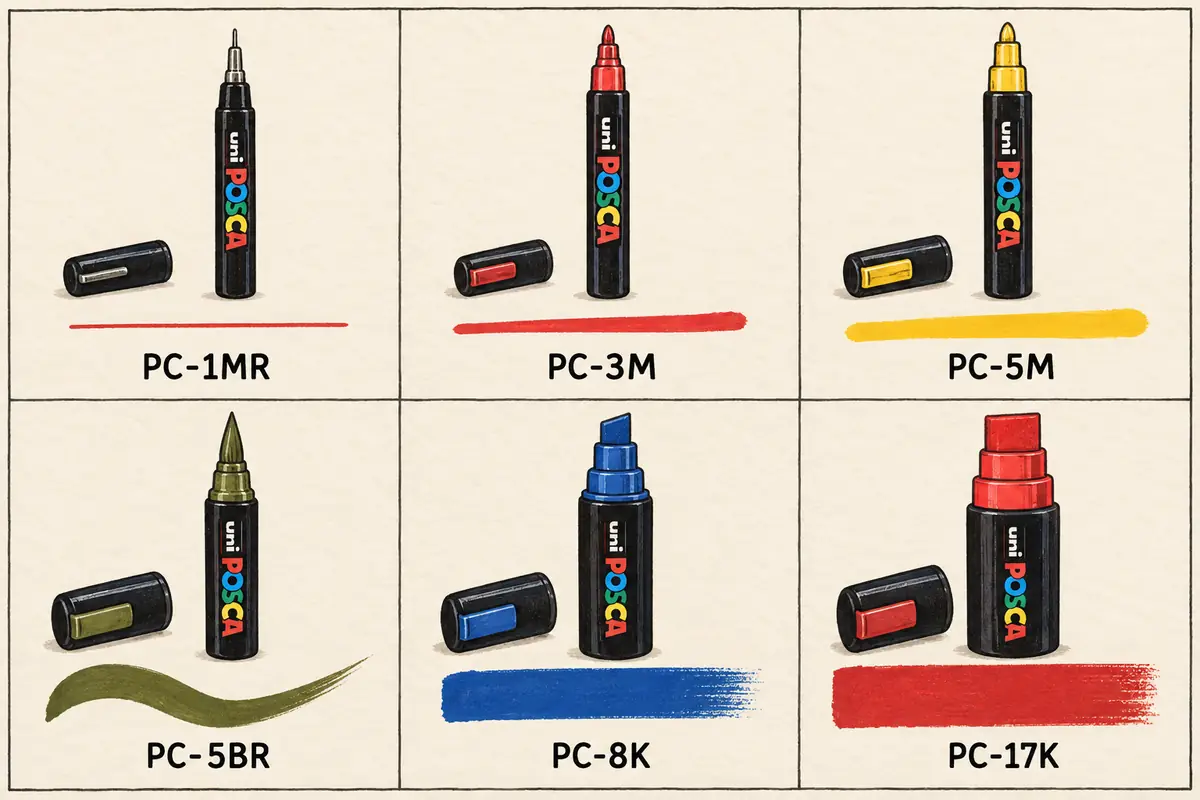
| Model and tip size | The mark I would use it for |
|---|---|
| PC-1MR: 0.7 mm extra-fine tip | Tiny labels and clean, thin lines |
| PC-3M: 0.9 to 1.3 mm bullet tip | Small drawings and card details |
| PC-5M: 1.8 to 2.5 mm bullet tip | Bold outlines and everyday paper art |
| PC-5BR: 1 to 4 mm brush tip | Fine-to-thick strokes with a semi-flexible tip |
| PC-8K: 8 mm chisel tip | Broad lettering, curves, and larger fills |
| PC-17K: 17 mm extra-broad tip | Flat backgrounds and large signs |
A fine tip and a bullet tip are not opposites. Fine describes the width. Bullet describes the rounded shape. The PC-3M is both. An artist who draws small borders may prefer that fine bullet tip, while an illustrator adding broad shapes may prefer the PC-5M.
The PC-5BR brush tip bends a little as you press. That gives an artist more range in a single stroke. The PC-17K covers far more space, but its broad edge leaves less room for tiny changes. I would choose the tip size at the size of the final art.
The surface changes the result
Paper, wood, glass, plastic, fabric, and stone do not hold paint in the same way. A set of paint markers is not a promise of the same finish on each one.
| Surface | What I would check first |
|---|---|
| Paper | Whether wet strokes lift fibers or buckle the sheet |
| Wood or stone | How roughness affects the line and tip |
| Glass | Whether the design needs to be removable or fixed |
| Fabric | The fabric's care needs and fixing instructions |
| Outdoor work | A suitable finish and the full exposure to weather |
Paper needs more care than it seems
A paint marker lays down moisture. A thin page may wrinkle. A rough or weak surface may shed fibers as the nib moves over it. Going back over the same wet spot can make that problem worse.
This shows up in a reader discussion about POSCA on journal paper. The original poster described streaks and small clumps. Other users pointed to the paper and repeated passes. It is a useful warning about the paper choice, not proof that every notebook will behave the same way.
I would start on a smooth, sturdy sheet. Make one patch, let it dry, and add a second layer beside it. Check the back as well as the front. That small test gives you a fair idea of how much paint the page can take.
Cutting a few small test cards is a good use for leftover paper. Our paper cutter guide covers tools for that kind of desk work.
Smooth surfaces need a clear plan
POSCA describes the paint as permanent on porous surfaces and removable from many smooth, non-porous ones. “Permanent” still needs context. A display piece, an outdoor sign, and an object that gets washed are different jobs.
Use the maker's instructions for the material you have. Do not assume that one clear spray suits every surface. I would also keep a first attempt away from a treasured or costly object. A spare tile or scrap of wood is a much better place to learn.
Rocks, plastic, and small craft pieces
POSCA paint markers can create bold patterns on rocks, plain planters, and many plastic objects. Clean the surface first. Test the paint and any finish on a spare piece. Smooth plastic may let a dry mark rub away more easily than rough, porous stone.
For canvas shoes or clothing, test both the color and the fabric's reaction. Follow the brand's fixing steps for that fabric. Ceramic designs may need a suitable fixative or heat treatment, depending on the item. Use the exact material guide. A decorative design is not a claim that the item is safe for food or washing.
Start the paint on scrap, not on the artwork
The press-to-start tip takes a little care. The first mark should be on something you can throw away, with the marker held over a protected work surface.
- Keep the cap on while you shake the marker.
- Remove the cap and gently press the tip on scrap until paint reaches it.
- Make a few test marks and check the flow.
- Move to your project with light pressure.
- Put the cap back firmly when you stop.
The aim is a wet tip, not a pool of paint. If the line feels dry, stop and check the marker. Do not keep forcing the nib into your drawing. That can turn a small dry patch into a large wet one.
Follow the brand's care and fixing advice for cleaning, storage, and surface-specific steps. It also explains when a tip can be washed or replaced. That is worth checking before you throw out a marker that still holds paint.
Give layers time to dry
For a crisp second color, let the first one dry. For a blended effect, work while the paint is wet. Those are two different aims. Switching between them by accident is a common way to get muddy edges.
I would practice both on the same spare sheet. Paint two small squares. Add a line over one while it is wet, then wait before adding a line to the other. The difference helps you plan the order of a real drawing.
Keep the nib ready for the next drawing
Store each marker with the cap shut tight. A dry nib can sometimes be washed with water as POSCA directs. Let the cleaned tip recover its paint flow on scrap. Check which replacement nib fits your model before buying one.
POSCA paint is water-soluble while wet. That helps with mixing and some cleanup, but it also means a damp hand can disturb fresh work. Let a finished design dry before you touch it. An artist who rushes this step can smear a crisp line with one thumb.
Is a set worth buying?
A set is useful when most of its colors fit the work you want to make. Singles make more sense when you need one missing shade or want to learn how a tip feels before buying more.
My starting list would be short: black, white, and a few colors that work together. Think in projects. A plant label may need two colors. A bright card may use five. Neither needs a huge collection.
Check the model code on the listing. A photo with a wide range of pens may not show what one selected box contains. Make sure the tip type, colors, and quantity are all stated clearly before paying.
Also think about refills and wear. A replaceable nib helps, but it is not the same thing as a refillable paint supply. I would price the markers I expect to use most, especially white and black, rather than judge value by the whole box alone.
Pick a color family you will use
The POSCA range includes soft pastel shades, neon colors, and metallic finishes. The choice varies by model. Sets can group colors by theme, such as cool tones or earth tones. The PC-5BR brush tip comes in 16 colors on the maker's current chart. A gold marker in one tip size does not mean the same color comes in every brush tip or bullet tip.
I would build a small palette around the art I want to create. Black and white can add strong detail. Blue, green, and a warm red can create a simple scene. An illustrator who needs exact hues should make swatches on the final paper. A cap is only a rough color guide.
For hand lettering and calligraphy, I would practice each letter at its final size. A brush tip can create a stroke that grows wider with pressure. A bullet tip gives a steadier rounded mark. Choose the one that helps you create the letters you want, then test it on the same paper as the finished design.
A few questions before you buy
Are POSCA markers waterproof?
The answer depends on the surface and how the work is fixed. Do not treat a dry mark on glass as equal to a finished outdoor piece. Check the material instructions before exposing the design to water or regular washing.
Will they work on a book cover?
They may suit a blank cover made for decorating. Test a hidden spot first. Cloth, coated card, leather, and glossy covers can all react differently. I would use an inexpensive blank cover for the first project.
Can I use them for tiny lettering?
Choose a fine tip for small lettering. The PC-5M suits larger letters and clear shapes better. Write a sample at the actual size of your project before buying a full color set.
Who should skip them?
I would look elsewhere for fast, broad coverage or long sessions of delicate color blending. A brush with gouache paint offers another way to make flat, opaque color, with more freedom to mix shades.
My final take
POSCA markers earn a place on a creative desk when the job calls for bold color in a controlled mark. The PC-5M is a sensible first choice for small signs, paper art, and painted details.
I would begin with a small set, a sturdy test surface, and a clear project. Learn the paint flow before adding more colors. The best part of a paint marker is how little you need to get started. Keep that part simple.
Keep making.
For a different way to work with color on paper, read our Ohuhu markers review.