
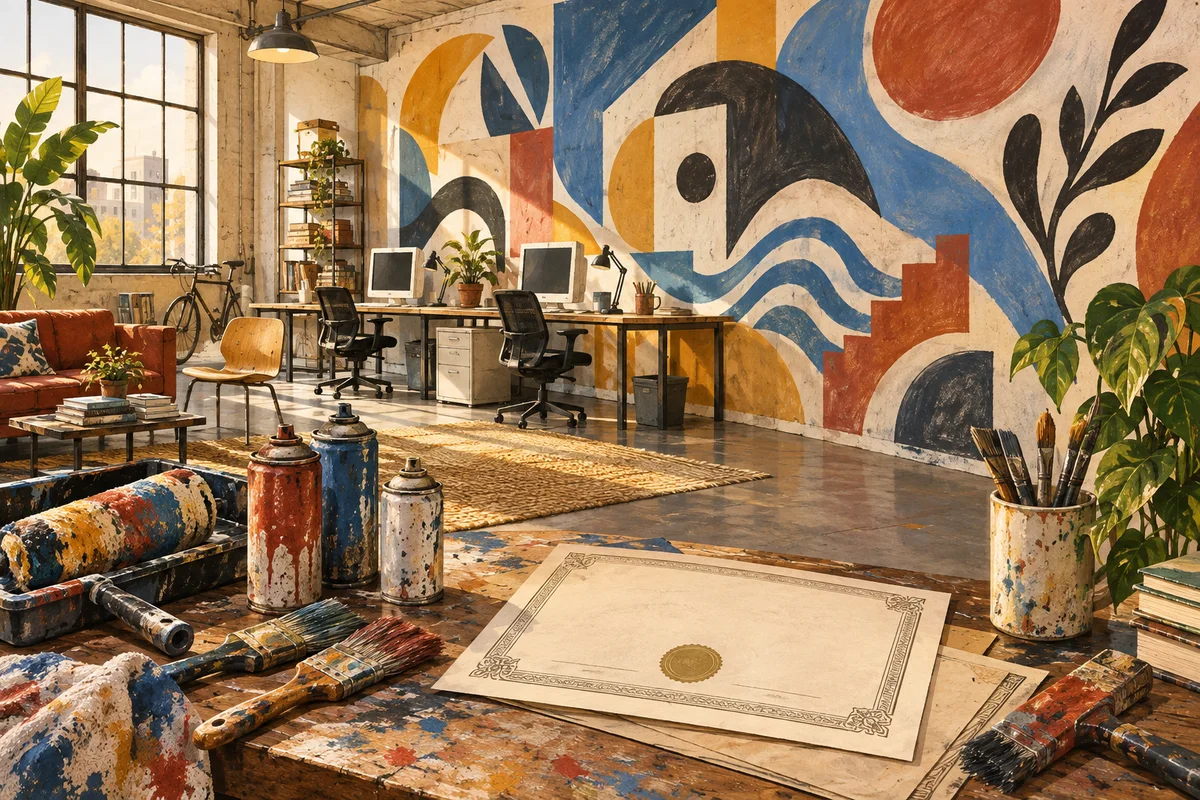
An artist paints an office. The company offers him a fee or a stake in the business. Years later, that stake makes headlines around the world. It sounds like a story told to persuade creative people to work for less. In David Choe's case, the deal was real.
The company was Facebook. The work was a set of murals. And the choice to take stock turned a painting job into one of the most famous windfalls in art.
Yet the best part of this story is easy to lose beneath the money. David Choe brought a career, a style, and a body of work to those walls. The shares changed his finances. They did not create the artist.
David Choe net worth: what do the numbers mean?
Celebrity Net Worth lists David Choe at $300 million. Treat that as the publisher's estimate, not a verified account of his assets and debts. The site itself says its figures are estimates unless stated otherwise.
The better-known $200 million figure has a different meaning. It comes from reports about Choe's Facebook stake around the company's 2012 stock market debut. It is a snapshot from that period, not a current price tag on his life.
This is why David Choe net worth estimates can run from $200 million to $300 million in different accounts. The figures describe different estimates and dates. They are not an audited range for his wealth today.
| Figure | What it describes |
|---|---|
| $60,000 | The cash alternative reported for the 2005 mural job. |
| About $200 million | The widely reported value of his Facebook stock around the 2012 IPO. |
| $300 million | Celebrity Net Worth's estimate of his total wealth. |
Those three numbers cannot be used as a personal account statement. Net worth means assets minus debts. A stock holding is only one asset. To know David Choe's current net worth, we would need to know what he still owns, what he has sold, and what he owes. The public estimates do not settle those questions.
The street artist before the Facebook money
David Choe is an American artist of Korean descent whose work crosses graffiti, painting, murals, and comics. Calling him the man who painted Facebook's walls tells you about one client. It leaves out the work that made him a person worth hiring.
A 2004 KQED profile, published before the Facebook job, described a street artist with gallery shows, magazine illustrations, and self-published graphic novels already behind him. His books included Slow Jams and Bruised Fruit.
KQED described an artist working with aerosol paint, acrylics, and watercolors. His work moved between the street and the gallery. That range matters: a mural is made for a room or a wall, while a comic unfolds in a reader's hands. Both need a strong sense of how an image holds attention.
By then, Choe was selling paintings and showing his work. He was not an unknown person who happened to find a spray can outside a tech office. He had a career in art before his name became a topic in business news.
For readers drawn to contemporary art, that is the more useful starting point. Look at the work first. A huge stock payout can explain a fortune without explaining why someone wanted the artist to paint in the first place.
David Choe's art beyond the office mural
In 2007, Choe held his New York solo exhibition Gardeners of Eden at Jonathan LeVine Gallery. The gallery's archive dates the show from January 6 to February 3. That was five years before Facebook went public.
David Choe's art career kept moving while Facebook grew. In 2010, KQED covered his Character Assassination exhibition at Fifty24SF in San Francisco. The review described a line outside the gallery and works hung across its walls.
One painting, Ignored Prayers, combined oil, acrylic, wax crayon, and spray paint. Cars, buildings, and dogs appeared within the hair above a woman's face. These were layered works full of small scenes, not just large marks made to be seen from a distance.
The exhibition helps put the Facebook mural in context. David Choe was a street artist who also made works for close viewing. His art could occupy a whole wall or pull a viewer toward the details of a canvas.
That part of his history gets less space than the stock deal. Yet the crowds at an exhibition, the pages of a comic, and the walls of a headquarters all show different ways his works reached people.
He later reached a TV audience, too. David Choe played Isaac Cho in the first season of Netflix's Beef, released in 2023. Netflix's cast guide identifies him as Danny's cousin. His art and screen work extend well beyond Facebook, though those credits do not tell us how much he earned.
The 2005 David Choe Facebook mural deal
In 2005, Sean Parker, then Facebook's president, approached graffiti artist David Choe about painting the company's office walls. According to ABC's Barbara Walters interview with Choe, Parker offered $60,000 or company stock. Choe chose the stock.
The street artist had doubts about Facebook. ABC reported that he had called it “ridiculous.” Taking Parker's offer of shares was hardly the safe choice that it can appear to be with hindsight.
Think about what Parker put on the table. Cash would pay for the finished work at an agreed price. Company stock would tie part of the reward to what happened after the paint dried. Facebook could grow, stall, or fail. The mural fee and the future value of the shares were two different things.
The Facebook headquarters became both a place to work and a place where Choe's art met a new audience. Reports of the deal often rush straight from that office to the millions. But there were years between the decision and the headlines.
Choe did the work when the outcome was still open. We know the ending now. He did not have that luxury when he made the choice.
What did David Choe paint on Facebook's walls?
Choe described the murals to Walters as a mix of women, city scenes, and abstract shapes. This was art made to fill a space. Staff saw it as they moved through the office, rather than making a trip to an exhibition.
The relationship continued. KQED's 2012 account described another Facebook mural commission in 2007, this time at Mark Zuckerberg's request. When Facebook moved offices, it had painted wall sections cut out and taken along.
That detail gives the mural a life beyond the payment deal. Office paint is often covered up when the next tenant arrives. Facebook treated the mural sections as works worth keeping. David Choe had made something the company wanted to carry into its next headquarters.
How the Facebook shares became a $200 million story
By early 2012, news reports were putting the value of David Choe's shares at about $200 million. Facebook was preparing to go public, bringing a market price and global attention to stakes acquired years earlier.
Facebook's own IPO pricing announcement set the offer at $38 per share. Dated May 17, 2012, it said trading was expected to begin the next day. An IPO, or initial public offering, is a company's first sale of shares to the public.
The dates matter. Choe painted for Facebook in 2005. Facebook's IPO came in 2012. That is roughly seven years, not an overnight return on a weekend with a paint roller.
Nor did Facebook write a $200 million check for a mural. The reported value came from owning part of a company that had become far more valuable. The artwork was the reason he received that stake, but the company's growth drove the windfall.
For an artist used to being paid for each piece or project, that is a striking shift. A fixed fee ends with the job. Ownership can keep changing in value long after the work is complete. In this case, the result went far beyond what an ordinary mural commission could pay.
Did David Choe keep all his Facebook stock?
No. In his 2012 interview with Walters, Choe said he had already sold some shares to make sure he would keep something if circumstances changed. That alone rules out treating his original holding as untouched.
It also helps explain why modern David Choe net worth estimates need care. We cannot take an assumed share count, multiply it by today's price, and call the result his wealth. A sale changes the number of shares he owns. The proceeds might be saved, spent, given away, or invested elsewhere.
There is a second gap between stock value and money in the bank. Stock prices show what shares are valued at in a market. They do not tell you the owner's sale price, costs, or final proceeds.
So the useful answer is modest: the Facebook deal brought Choe a widely reported fortune. The exact amount of that fortune he holds today is not established by those old reports. That uncertainty does not make the mural deal less remarkable.
What artists can learn from David Choe
David Choe's experience gives weight to Jodi Bando's point about ownership. A person who shares in a business's success can earn far more than a flat fee. But one huge success does not show how often that outcome occurs.
There is a risk on the other side. FINRA explains concentration risk: holding a large share of your assets in one investment can make losses more severe. It also notes that some private investments can be hard to sell when you need cash.
That is why the details matter more than the promise. Shares, stock options, and revenue share are different forms of payment. An option is a right to buy shares on set terms. Revenue share is a claim on a defined stream of revenue; it need not give the artist ownership of the company.
Before you sign a deal that trades a fee for shares, ask four practical questions:
- What payment is guaranteed for the work?
- What exactly is being offered in place of cash?
- When can the artist receive or sell it?
- Could the artist afford the project if the extra reward never arrives?
The lesson is to understand what you are being paid with. A stake can be valuable. It can also leave you with finished work, spent time, and little to show for it. Choe's outcome is a reason to pay attention to ownership, not a reason to treat every offer of shares as a winning ticket.
Quick questions about David Choe's wealth
Is David Choe the richest graffiti artist?
There is no verified public ranking that settles that claim. Wealth estimates put him among very rich artists, but a comparison would need reliable figures for each person. The Facebook deal is famous enough without giving Choe an unproven title.
Did Facebook pay David Choe $200 million to paint a mural?
No. Choe accepted company stock in lieu of cash for the 2005 work. The roughly $200 million figure was a later estimate of that Facebook stock's value. It was not the price of the mural.
Does selling a painting always add to an artist's net worth?
A sale brings in revenue, but revenue is not the same as profit or wealth. Materials, a gallery's share, and other costs affect what the artist keeps. A resale can also pay a collector rather than the artist. An auction price alone cannot tell us Choe's earnings.
A fortune made possible by a painting job
The Facebook mural story sits at an unusual meeting point between art and business. It began with a client wanting an artist's work on its walls. It became famous because the artist accepted a piece of the client as payment.
That is what makes David Choe worth reading about even if you came for a net worth figure. The reported millions are the hook. The lasting idea is that the form of payment can matter as much as the fee.
David Choe brought the paint. Facebook supplied the shares. Time gave that mural job a place in the company's history. For the artist, it meant that the value of his work could grow long after he left the office.
Keep making.
Find more art stories and practical guides in the Cover Maker journal.